
Tucker County Court Records After Arrest
After a Tucker County arrest, the jail record and the court record answer different questions. The DCR roster answers whether a person is in regional jail custody now. The court record answers what case was opened, what charges were filed, what bond conditions were set, and how the case moved through magistrate or circuit court. DCR's own jail-search disclaimer says sentencing information on the jail search is not intended to reflect the underlying criminal action and that court records should be used for the criminal case.
The usual path is arrest, transport to Tygart Valley Regional Jail, intake, initial appearance, prosecutor review, charging document, and court case. For custody and booking details, use Tucker County jail inmate records. For booking-photo issues, use Tucker County jail roster mugshots. The court side starts when a complaint, information, indictment, amendment, dismissal, plea, or other case entry is created by the court process.
Search Court Records After Arrest
Start with the lower-court path when the case is new. The West Virginia Judiciary describes its Magistrate Record Search as a free way to increase access to online magistrate court information. The direct Magistrate Case Record Search portal can be searched by first name, last name, or case number after the user passes the entry gate.
- Search the magistrate portal by defendant name if the case is new, misdemeanor-level, or tied to an initial appearance.
- Use a case number when one is available from a jail record, clerk, citation, notice, or court paper.
- Review each result for county, case type, charge language, and current status. The Judiciary notes that result lists may be limited.
- For felony or circuit-level matters, use WVPASS or contact the Tucker County Circuit Clerk.
- Call or visit the proper clerk for copies because online systems may provide indexes rather than the actual filed documents.
The West Virginia court-record access page links users to statewide circuit and magistrate routes. WVPASS searches circuit court records from all West Virginia counties, but the research could not capture a complete WVPASS field inventory because the page loaded as a web app.
The Magistrate Case Record Search screenshot below shows the entry point used for Tucker County magistrate case lookups after an arrest.
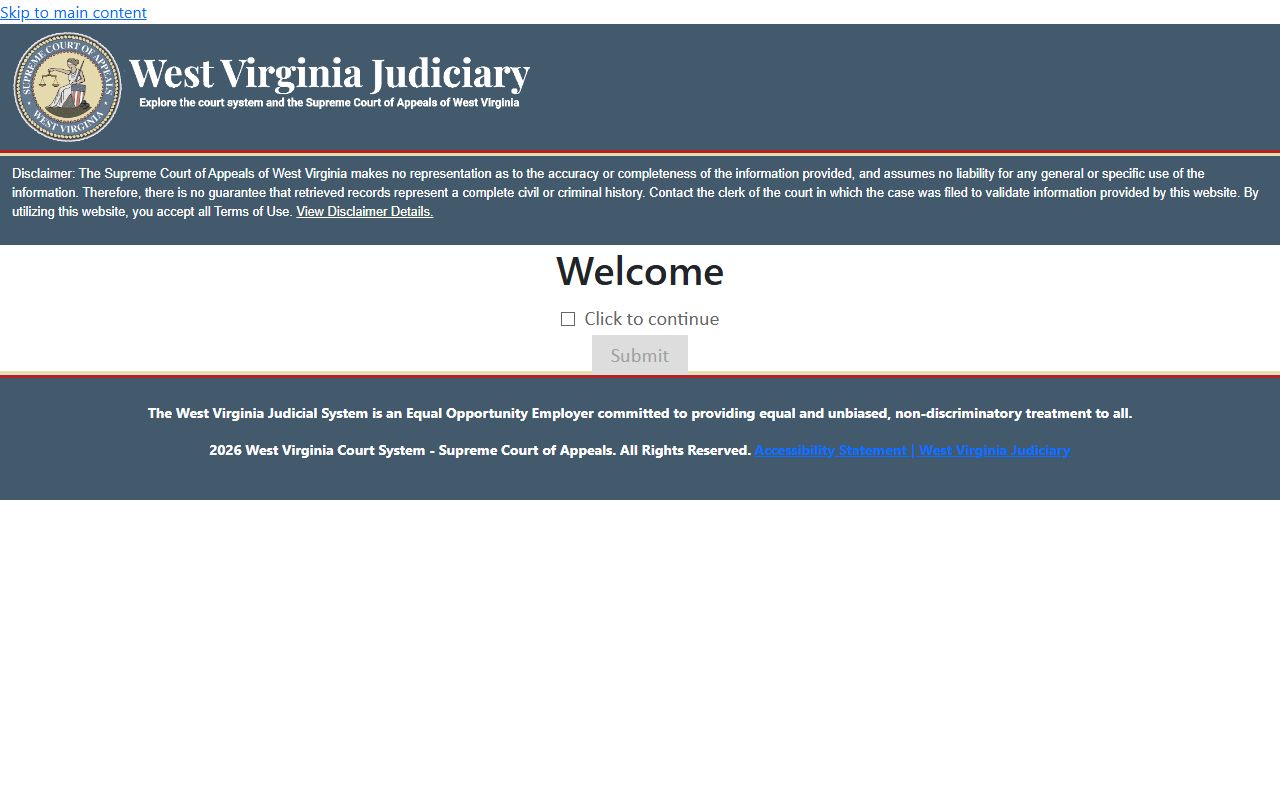
That portal is useful for case leads, but document copies and official verification still come from the local magistrate court clerk.
Tucker County Magistrate Search Fields
The magistrate search does not require a long form. It is built around names, case numbers, and a gate before submission. The Judiciary also notes that a search may generate a list of up to 30 records, so narrow names help when a common surname returns too many matches.
| Field Label | Type | Required | Options / Format Notes |
|---|---|---|---|
| First name | Text | Unspecified | May be used to narrow a defendant name search. |
| Last name | Text | Unspecified | May be used alone or with first name. |
| Case number | Text | Unspecified | Best when a citation, notice, clerk, or jail record provides the number. |
| Click to continue | Checkbox or gate | Yes | The portal landing page requires continuing from the disclaimer gate. |
| Submit | Button | Not applicable | Submits the search after the gate and fields are complete. |
| Result limit | System limit | Not applicable | The Judiciary information page describes a list of up to 30 records. |
Use magistrate search results as an index. The Judiciary says court documents themselves are not available online through that system, so users must call or visit the magistrate court clerk in the county where the case is filed for copies. A nominal fee required by law may apply.
Tucker County Charging Documents
A booking charge may be broad, short, or entered before full prosecutor review. The court charge is built through a filing. In Tucker County, West Virginia uses the Prosecuting Attorney title rather than District Attorney. Prosecuting Attorney Savannah Hull Wilkins is listed as responsible for prosecution of crimes committed in the county, with Assistant Prosecuting Attorney Karlie Carlisle also listed in the research.
| Document | Who Uses It | What It Usually Means |
|---|---|---|
| Complaint | Officer, prosecutor, and magistrate process | Often starts an early criminal matter in magistrate court, including initial lower-court proceedings. |
| Information | Prosecutor | A formal prosecutor-filed charge in circuit court, generally without grand-jury indictment. |
| Indictment | Grand jury | A formal felony charging document returned after grand-jury action. |
The charging document is the bridge between arrest and the court record. Felony matters can move from magistrate court into circuit court by indictment or information. Charges may be amended, reduced, dismissed, or resolved by plea, so the first booking label should not be treated as final.
Tucker County Charge Status
Charge status describes where the accusation stands in court. A charge can remain pending, change by amendment, be reduced, be dismissed, be sent onward from magistrate to circuit court, or end in conviction or acquittal. The same arrest can produce more than one charge, and each charge can have a different status.
| Status | What It Means |
|---|---|
| Pending | The case or charge is still active and has not reached a final disposition. |
| Amended | The prosecutor or court changed the charge language or filed a revised charge. |
| Reduced | The charge was lowered to a lesser offense, often through plea or prosecutor action. |
| Dismissed | The charge ended without conviction. |
| Acquitted | The defendant was found not guilty. |
| Convicted | Guilt was entered by plea or verdict. |
| Bound over | A felony matter was sent from magistrate court toward circuit-court process. |
| Indicted | A grand jury returned a formal charge. |
Bond After Tucker County Arrest
West Virginia bond decisions are tied to W. Va. Code §62-1C-1A, which directs judicial officers to use the least restrictive condition or combination of conditions reasonably needed for appearance and safety. Conditions can include obeying the law, supervision, home incarceration, electronic monitoring if available, no contact, substance-use limits, cash bond, property, or surety bond.
- Personal recognizance
- Release based mostly on a promise to appear, sometimes with nonfinancial conditions.
- Cash, surety, or property bond
- Money, a solvent surety, or approved property secures future court appearance.
- No-bond hold or detainer
- Another warrant, parole hold, DOC commitment, federal hold, ICE detainer, or court order may block release.
For a Tucker County arrestee, confirm custody with Tygart Valley at (304) 637-0382, then confirm bond conditions with Tucker County Magistrate Court or the Circuit Clerk depending on the case level. No official Tygart Valley source located accepted payment methods, bond counter hours, or online bond payment fees, so call before trying to post bond.
Warrants Before Court Records
No official Tucker County Sheriff active-warrant search page or most-wanted page was located. That means a lack of online warrant results should not be read as proof that no warrant exists. Warrant questions should be routed through the issuing court or the law-enforcement agency that serves the order.
Tucker County Magistrate Court handles many lower-court warrants, complaints, bail, and initial criminal proceedings. The Sheriff's Department serves processes and makes arrests. The Circuit Clerk can help with circuit-level case records. Magistrate and circuit searches may show cases tied to bench warrant or capias activity, but they are not complete warrant databases.
Charges Versus Convictions
A court record after an arrest may show charges long before any final outcome. A charge is an accusation. A conviction is a final finding of guilt by plea or verdict. This distinction matters for Tucker County court records because a booking charge, a filed charge, and a final conviction can be different.
Charge: an accusation filed or pursued in court. It can appear early after arrest and may be changed, dropped, dismissed, or resolved later.
Conviction: a final guilty plea or guilty verdict. It can lead to sentence, supervision, fines, or custody.
Sealed or Expunged Records
West Virginia law provides expungement routes for some dismissed charges, not-guilty outcomes, deferred adjudication, pretrial diversion, and certain convictions. Eligibility is not automatic. The court file, the disposition, waiting periods, charge type, and statutory exceptions all matter.
Sealed: ordinary public access is hidden or restricted by court order, record type, or a protected case category.
Expunged: a qualifying court process removes the record from public view under statutes such as §61-11-25 or §61-11-26.
Note: Court-record clearing does not work by editing a jail roster page. The order must come from the court and then be applied by the record custodians that hold affected records.
Tucker County Court Contacts
Use the clerk that matches the case level. Magistrate court is the usual start for initial appearances, many misdemeanor cases, complaints, and preliminary matters. Circuit court handles felony, higher-level, and transferred matters, along with other court functions.
Tucker County Circuit Clerk
Sharon Moats
211 First Street, Suite 403
Parsons, WV 26287
304-478-2606
sharon.moats@courtswv.gov
8 a.m. to 4 p.m. Monday-Friday
Tucker County Magistrate Court
Brenda Arnold, Clerk
211 First Street, Suite 303
Parsons, WV 26287
304-478-2665
Fax: 304-478-4836
Tucker County Prosecuting Attorney
Savannah Hull Wilkins
211 First Street, Suite 207
Parsons, WV 26287
304.478.3511, Ext. 7003
8 a.m. to 4 p.m. Monday-Friday
The Tucker County Circuit Clerk page screenshot below shows the county source used for circuit clerk duties, address, phone, hours, and copy information.
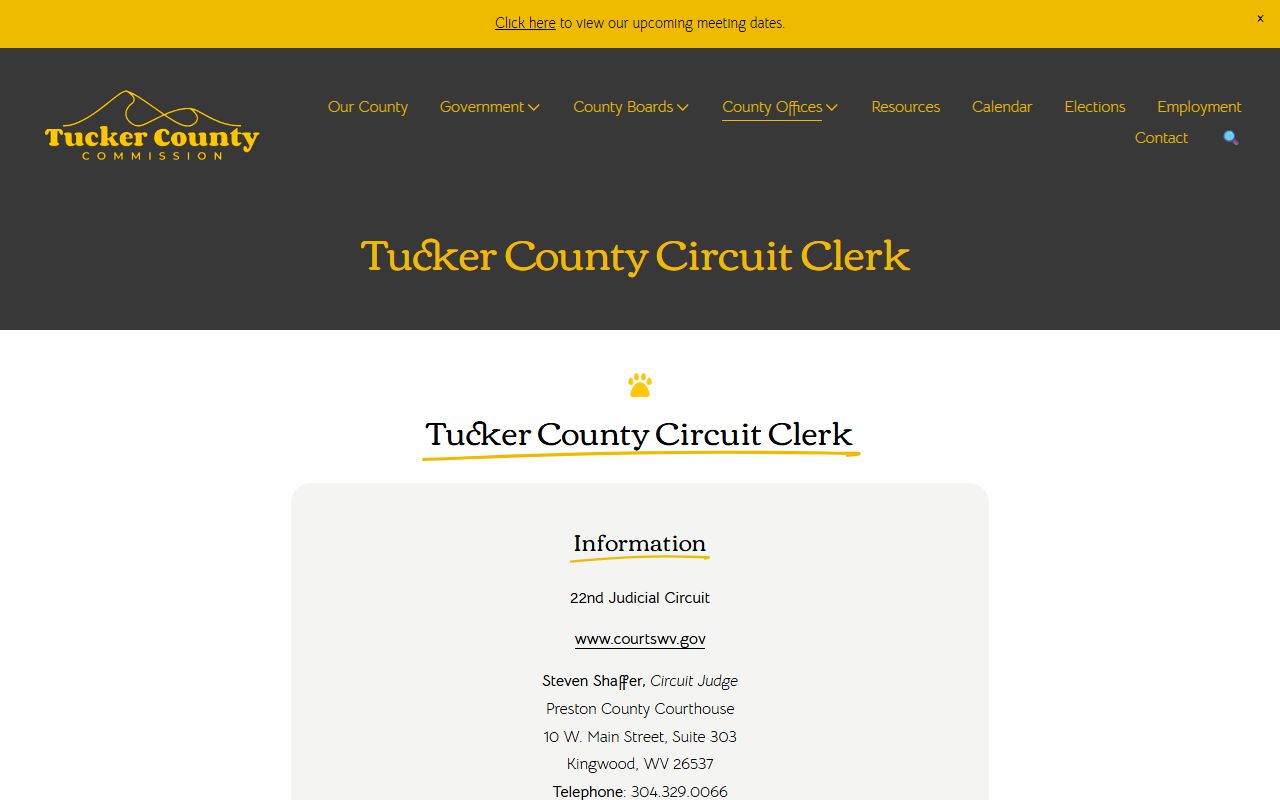
For filed documents, the clerk is the practical source. The prosecutor's office explains the prosecution role, but it is not a substitute for the court file.
Tucker County Court Access Limits
Executive-branch records, such as sheriff arrest reports or some jail records, may be requested under West Virginia FOIA. Court records follow judiciary access and copy procedures instead. W. Va. Code §29B-1-3 sets the five-business-day public-record response rule for custodians, while §29B-1-4 preserves exemptions for privacy, law-enforcement investigative material, and records exempted by statute.
Juvenile matters, sealed records, expunged records, sensitive victim information, and ongoing investigations may be restricted. A court index may show enough to identify a case, but copies may still require a clerk request, a fee, or a court order. The safest rule is simple: use the roster for custody, the court search for the case, and the clerk for official copies.